I watched all the Jacques Costeau episodes as a kid. Obviously I learned nothing from his crew’s underwater photography techniques. What I did was reach out of the kayak, stick the waterproof camera in the water, and snap photos while fish swam by. I snapped a lot of nothing, and then this little fish happened by at the right moment. A not-so-large large mouthed bass.
Failing at my Calypso crew audition, now I seem afflicted with Joyce Kilmer aspirations:
Long Lake, little fish
Long Lake, little wish
Wants to see the internet
Not a cute pet
Has to stay wet
Has to stay put
Has to stay free
Bet she’ll greet a fishing net
Before she meets that internet
Poor little fish
Poor little she
The Narrows connect the upper and lower lobes of Long Lake. This is near the South end of the Narrows. Lynne Rossetto Kasper’s The Splendid Table has nothing on this special spot. The table is set with flowers, appetizers (but these varieties of mushrooms might be poisonous). An altogether nice place setting, just waiting for the meal to arrive. I’ve seen dragonflies land on the stumps, resting on their way to their next mosquito. Small bluegill sometimes gather in the shade. I like to park my kayak nearby and just watch to see who turns up.
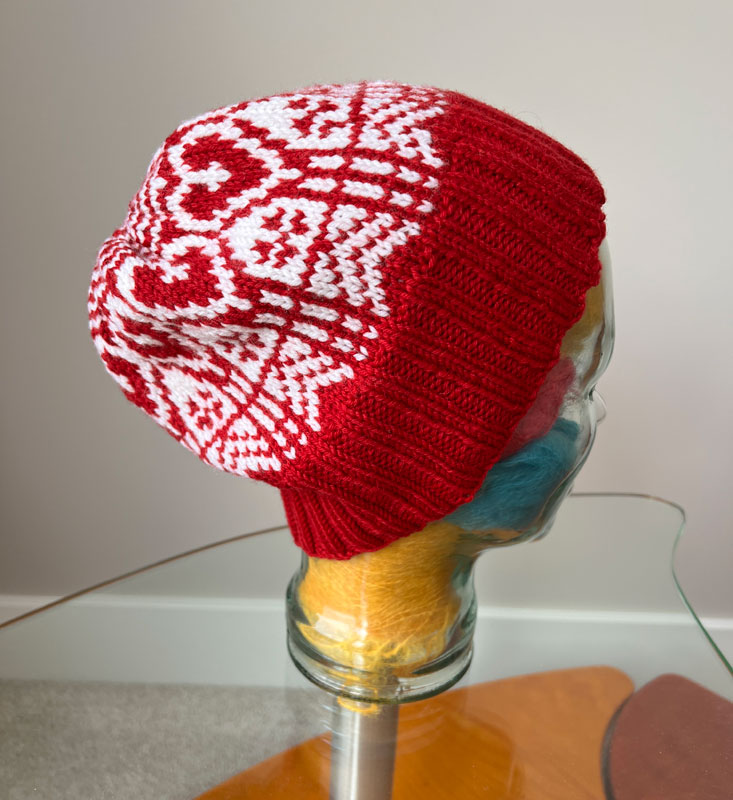
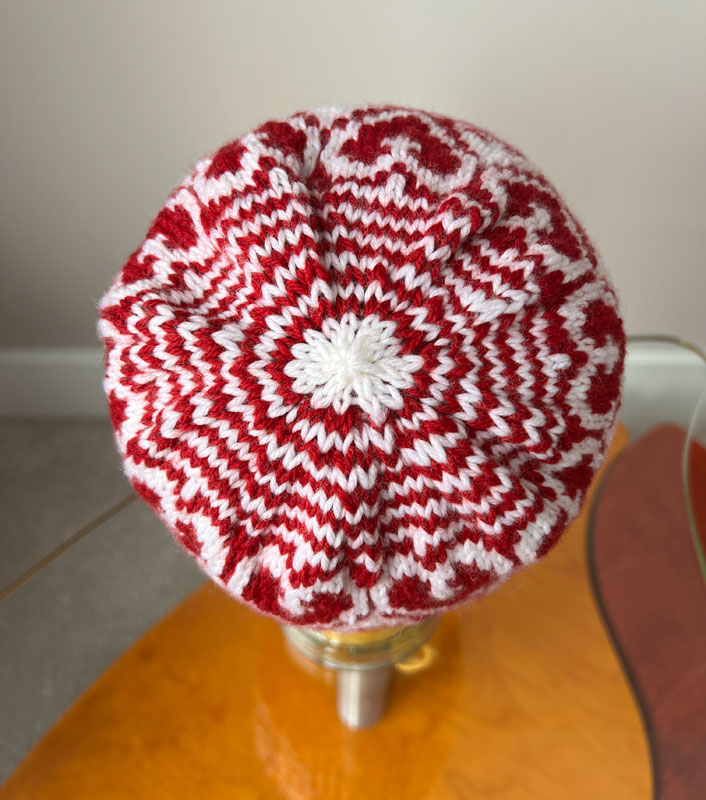
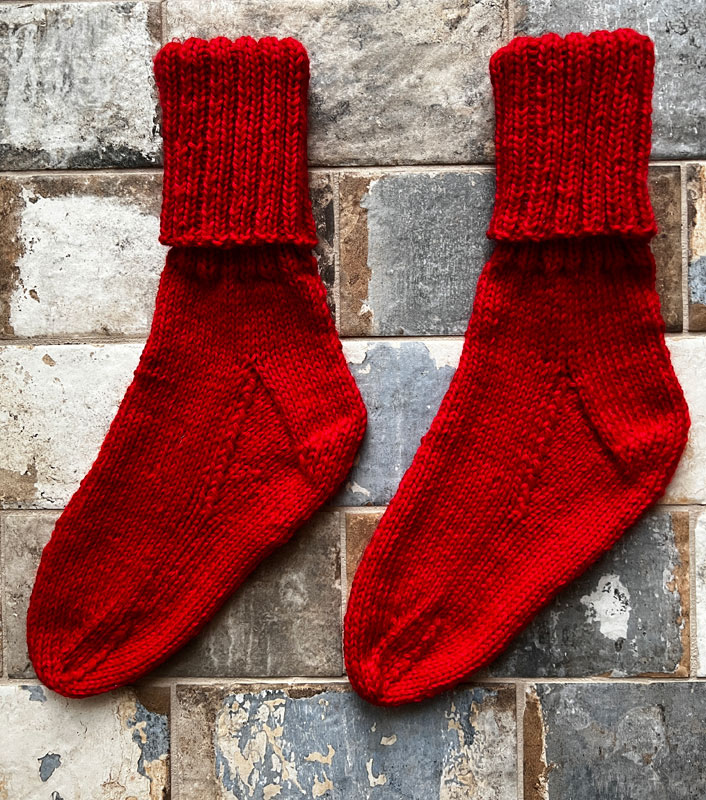
It’s been very hot in Michigan lately. Even at the lake, temperatures reached into the 90’s. This is perfect weather for small projects. 60 Quick Knits is a great new book that features all Cascade 220 yarns. 20 hats, 20 scarves, and 20 mittens. This one is Bobbles and Cables designed by Suvi Simola. A fun, quick knit, worked up in Cascade 220 wool.
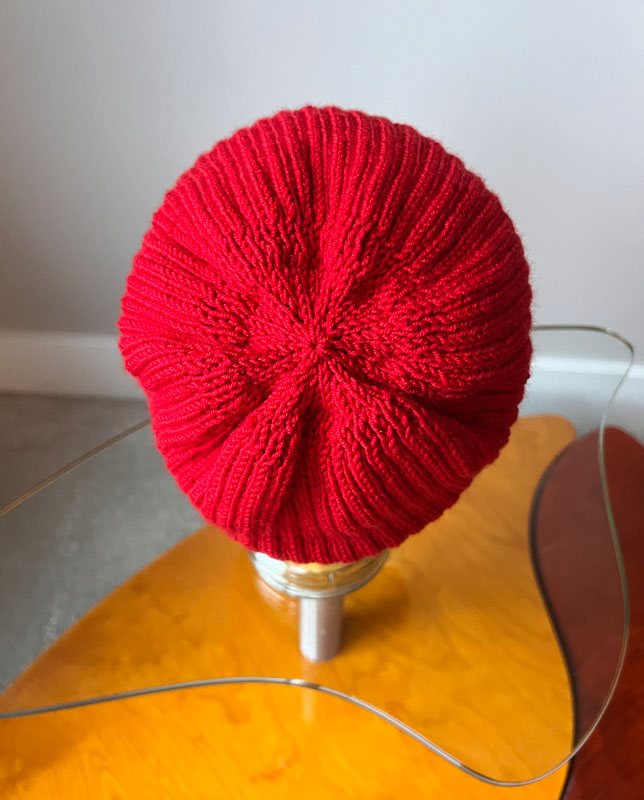
Starfish Hat, by Anne Farnham, worked up quite nicely. I moved the needle size up one beyond gauge, to get a bit more slouch in the main section. The bit of lace and bobble mix is easy peasy and adds a nice touch. And at the crown, the decreases form a starfish shape. This electric green will brighten up a wintry day. Cascade 220 wool has such a wonderful selection of colors.
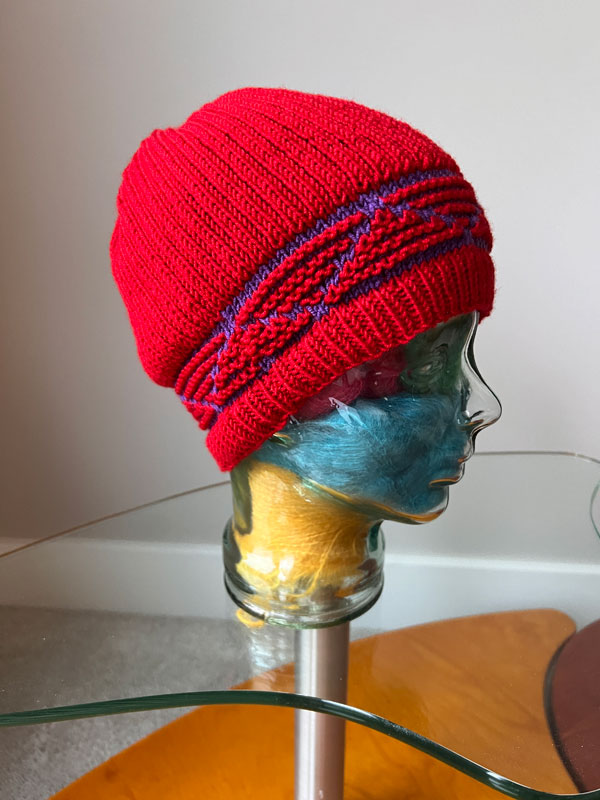
This one, knit in Cascade Quatro, is “Tasseled Topper” by Linda Medina. That must make mine: No-Tasseled Topper” and I think it works nicely. Not a fan of tassels, but I like this hat.
Cascade’s new book is great for knitters looking for small projects in worsted weight yarns. In the last few weeks, I’ve knit these three hats and have already started my second scarf from the book.

Durenda Pake’s “Yarns To Go” shop is located at 127 Second Street, in the heart of downtown Alpena. She has a wonderful selection of natural fiber yarns, as well as acrylics. I’ve never knit with Plymouth Yarn’s Galway and so I selected these two shades for a pair of fair isle mittens. It’s a yarn that looks quite comparable to Cascade 220–maybe a bit more “refined” and a bit tighter twist. On US size 8’s it should knit up at 5 stitches to the inch. So says the ball band. The yarn is spun for Plymouth Yarns in Peru.


Naturally Nazareth is a “100 percent domestic wool” that I am not familiar with. Yarns To Go has a small selection of what the ball band describes as Aran weight (4.5 stitches to the inch on US size 8 needles). The yarn is produced by Kraemer Yarns. I puzzled over the “Naturally Nazareth” yarn name–until I saw that the yarn is spun in Nazareth, Pennsylvania. I plan a scarf for the variegated yarn and a pair of mittens for the black and natural.

Locally, Cascade 220 is getting to be hard to find. Maybe the shops have mostly abandoned the yarn to the internet sellers. The shops nearer to home have started stocking Ella Rae, instead. Good yarn, but not Cascade 220. I like the somewhat more rough look of Cascade 220 better. Plus Ella Rae is more expensive.
So, if you are in Northeast Michigan looking for yarn shops, be sure to check out Yarns To Go. Nice people. Helpful. Lots of yarn. And a surprisingly complete and up-to-date selection of books.

We spotted this shy Northern Water Snake as he was swimming near the kayak put-in. He startled me, for sure. We don’t see many snakes swimming in the lake. In fact, in four years on the lake, this is only the third one we’ve seen. He swam very fluidly. Clearly the little guy is comfortable in water. He was only about two feet long and, at his thickest, he was about one and one-half inches in diameter. These snakes grow to about four feet, so this was probably a young one. You can also tell that because he is more distinctly patterned than an adult would be.
The Northern Water Snake is harmless. The worst they will do is release a foul-smelling anal secretion if you handle them. They are nervous snakes and if handled they will try to bite, but they don’t have any venom. Sometimes these snakes are misindentified as “water moccasins.” We don’t have water moccasins in Michigan. Maybe on account of that misidentification, or possibly just because lots of humans fear snakes enough to want to kill them, Northern Water Snakes have been wiped out in some areas of Michigan. Long Lake is fortunate to have some left.
In the lower peninsula, the only snake with a poisonous venom is the very very shy Eastern Massasauga Rattlesnake. They aren’t anywhere near as dangerous as their southern and western cousins. Pretty much Michigan’s rattlesnake only bites silly people who are trying to handle them. A bite means a trip to the hospital rather than a trip to the morgue (except for the extremely fragile). Michigan’s upper peninsula has absolutely no snakes that harm humans.
So, another good reason to live in Michigan: only one of our snakes can be harassed into trying to kill you. And they aren’t very good at it.


Is this like knitting on eight needles? Talk about lace weight.
This spider has been working on the outside of one of the great room cottage windows since I arrived on Friday. The farthest out part of the web gracefully drapes 51 inches from the top to the bottom. Measured across at the bottom of the window this triangular shaped web is 43 inches. The silk circles from a center spot, sort of. It’s kind of sloppy knitting though. And the threads are held together with crisscrossing strands. In this photo it seems to be doing some repair work on the web. I’ve watched it use a couple of those shorter legs in front to shovel little gnatty tidbits into its mouth.Very efficient. Its body is about half an inch long. Measured from longest leg to longest leg, it’s about 1.5 inches.
I’ve tried to find out what this spider is. We have the Audubon Society’s Field Guide to North American Insects and Spiders. But, I’m sorry, even touching the glossy color photos in that book long enough to turn the pages gives me the creeps. I thought maybe if I just steeled my resolve and got past the really ugly stuff and went straight to the spiders, I’d be OK. But even the spiders are more than my queasy me can manage. Back lit, the creature just sort of looks like a big spider. Photographed by Steve and his macro lens, it’s hideous, in an interesting way. The windows don’t open on this side of the room, so that’s good. Seeing the little hairs on its legs is more than I want to know about an arachnid dangling this close to my dinner table.
Are there any spider experts reading my blog? I got through the Audubon book enough to decide that this might be a Mottled Orb Weaver. Care to comment? The only poisonous spider in Michigan is a Black Widow, and this isn’t that. So, another good reason to live in Michigan. Michigan bugs hardly ever kill you.


In 2009, no Long Lake Loons nested successfully. At least one pair, and it seemed a few unpaired adults, summered on the lake. But no chicks. Two couples got a bit of an early start this year on their nests. Male and female alternate sitting on the eggs. By June 25th, this pair’s two chicks had hatched and they were off their parents’ backs. (They only get to hitch a ride for about a week.) The chicks were already diving for food, though I didn’t see them catch anything. They were “viewing” just like their parents–putting their heads into the water and peering around looking for tasty bits. Their loony foot waggle is already perfected. This family group paddled by my kayak, accepting my presence without any sign of stress or agitation. They came so close I could hear the chicks cooing. There is something so compelling about these creatures.
A second pair seems to be sticking to the bigger north section of the lake. Their nest was probably the one on the west side of Belly Button Island. There were two eggs in that nest, but only one chick survived. Unlike the family group to the south, the pair with one chick is acting very wary. The mother and chick still came quite close to our dock, though. The male is yodeling off intruders and repeatedly going into “vulture pose,” where he pulls himself up out of the water and makes himself look more fierce.
Good. They need to keep that one chick safe. There are big snapping turtles, pike, and hungry Bald Eagles on Long Lake.
We need to keep the loons safe too. One easy thing we can do? They all eat little rocks from the lake bottom to aid digestion. But if a loon eats a lead fishing sinker instead of a rock, they are toast. They die of lead poisoning. There can’t be a better reason to get the lead out, anglers!
May all three chicks make it to their October adolescence.


Swamp Milkweed (Asclepias Incarnata)
Smooth Rose, Meadow Rose (Rosa Blanda)
The small peninsula that helps frame our bay is filled with these beauties. I’m no gardener. And flower identification is not my skill. But I’m pretty sure that the top flower is swamp milkweed. Asclepias incarnata. They like to grow at the water’s edge, where this bunch is thriving. Their roots are especially adapted to living in wet soil that is oxygen starved.
Most varieties of milkweed are poisonous. They contain cardiac glycosides that can interfere with heart function. Some bugs love to munch on them anyway. Milkweed beetles. Milkweed bugs And the caterpillars that end up as Monarch butterflies. These bugs tolerate the poison and typically signal their poisonousness to birds by being colored yellow and black. You can learn a lot about swamp milkweed here and here. Birds use the hairs of the milkweed to line their nests. Oh, the flowers aren’t poisonous. Still, I would think it best not to toss them in your next salad.
The second beauty is Smooth Rose, a/k/a Meadow Rose. Fancy scientific name: Rosa Blanda. It grows to about three feet high. It likes moist soil. With Long Lake constantly lapping up onto the peninsula, it can’t get much more moist. And this year we’re going for the record on rainfall. The wildflowers are apparently lovin’ in.

The trio of washcloths in this post are designed by Evelyn A. Clark. The patterns were published by Fiber Trends in a booklet called “Bathtime Blossoms.” They are worked flat, in short row wedges. Eight wedges to a cloth. I knitted mine in a discontinued Rowan “100% organic” cotton that’s been in my stash for about a dozen years: Fox Fibre. Size 3 needles. Clark calls the first one “Flowered Wreath.” Next is “Blossom.” The last one is “Scattered Flowers.” They are each a quick knit.
But why do I knit such things? I have no idea. They are not exactly mindless. They are not exactly useful. They are not exactly useless. They are just kind of pretty.


Growing up on the east side of Detroit, we called them June Bugs. Steve grew up in the same neighborhood and he called them Mayflies. According to Wikipedia, these guys have a boatload of aliases. Fishfly, Dayfly, Shadfly, Green Bay fly, Lake fly, Jinx fly. They are members of the order Ephemeropter. Same Greek root as ephemeral. Short-lived.
What we see is just the end, and a very brief end, of a much longer life. In their immature naiad stage, these bugs can live up to four years in stream beds and lake bottoms. They look more like beetles during that phase. Some species transition through up to twenty moults. When the time is right to hatch and mate, they are often launched airborn in a rising bubble of air. Actually, lots of rising bubbles of air. The hatch can be very impressive. Reports are that a hatch on Lake Erie once showed up on Doppler Radar.
Once hatched, Mayflies mate quickly and on the fly. Both male and female are doubly endowed when it comes to their mating paraphernalia. The male dies straight away. Females may live a day or so. Once they emerge from the water, with their skinny segmented bodies and delicate veined wings, they’re done with eating. Their digestive system is filled with air. That makes them light enough to float.Their mouths are just vestigial.
A prolific hatch is sometimes taken as a sign of the general health of a river or lake. Long Lake must be pretty healthy. They arrived yesterday in great numbers. The Purple Martin are gonna have major tummy aches tomorrow because they’ve been buzzing around all day eating their fill. They’ve even been swooping in to pluck them off our dock. Hundreds of the bugs are clinging all over our lake house. In the morning, our walk to the water will be very crunchy.

|
|